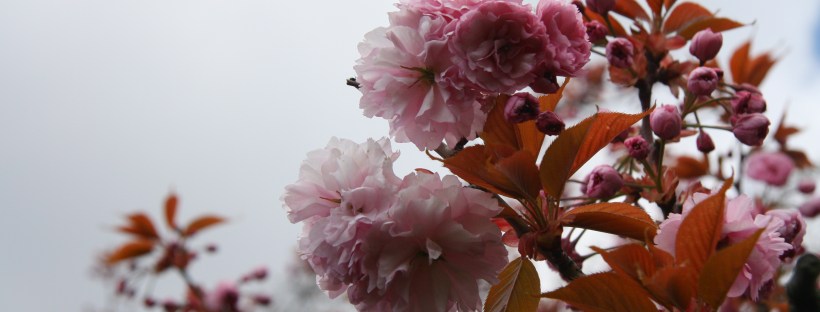
On a walk through Greenwich Park a few weeks ago, I noticed a temporary stall staffed by a couple of park rangers. I kept going for a minute, before something compelled me to turn back. I asked them about their experience of working in the park, and they gave me a flyer highlighting opportunities to get involved. From there it was a few short steps to register on the volunteering portal, and this was how I found myself on a recent afternoon, wearing a fetching maroon coloured hi-vis jacket and a pair of safety goggles, ripping brambles out of the earth.

The shift had been billed as a snowdrop planting session, which seemed odd since the wave of small white flowers that heralds the beginning of the end of winter had already passed. However, by the time I arrived, the morning crew had already completed this task, leaving just a few final bulbs which I was given to stuff into some holes in the grass. From there we moved to another location in the park, working as a team to clear away prickly undergrowth that was choking a young hawthorn tree.
‘To plant a garden is to dream of tomorrow’
Reflecting on the experience afterwards, it struck me that my seemingly spontaneous decision to volunteer was in fact the result of a seed planted a while ago. In June of 2023, I spent a fortnight in Paris for a ‘creative flow’ summer art school programme. With Esther Sherrow as our wise guide, we spent two weeks exploring what creativity meant to us, as individuals and a group. Esther offered us half an hour at the beginning of each day for free writing – inspired by Julia Cameron’s practice of morning pages. This was transformational, and initiated a practice of daily writing which has nourished me deeply for nearly two years.
I didn’t need any writing prompts during the first week. There were many things preoccupying me at that time which spilled into my notebook like an oil slick. In the second week, I looked up from my internal monologue, and asked Esther for some topics to guide me. One day she suggested writing about ‘five imaginary lives I could be living’. I struggled at first to stop censoring myself with the tyranny of what sounded ‘realistic’, but once I connected to the imagination, I was surprised by what emerged. Some things felt obvious, like a life where I was running a wine bar bookshop. But the world where I was a park ranger, ‘living in a hut with responsibilities for conservation and tour guiding’, was more unusual. I’ve never had a green thumb, and until recently did not consider myself particularly ‘outdoorsy’. Yet the idea of spending most of my time in nature had a deep appeal.
In hindsight, I think that the act of articulating that alternative life was the thing that encouraged me to go back and pick up the volunteering leaflet, and actually follow through on what might otherwise have remained an idle daydream. I’ve noticed that other things I wrote about that day have also manifested themselves in unexpected ways. I’m not planning to open a bar any time soon, but I did recently spend two months completing the WSET Level 2 qualification in wines. And the outlandish notion of being a ‘professional traveller’, spending six months of each year exploring the world while experiencing, learning and growing came true in the form of my 2024 sojourn in Spain.
Reaping what you sow
I went back for a second shift in the park the following week, which involved pulling up grass and weeds that were choking a line of sapling trees and then spreading mulch to help them grow. It made me think further about the nature of what we plant, and how we tend to it to ensure that it has the best possible chance of thriving.
It sounds obvious, but what you plant – literally and metaphorically – is what will grow. If you cultivate fruits and vegetables in a kitchen garden, you may be able to feed yourself, friends and family with what is produced. If you scatter wildflower seeds in the soil, with any luck you’ll get a riot of unexpected colour in the springtime. Even if you don’t do anything (which describes the recent state of affairs in my balcony planting pots), random weeds may grow by chance. The same is true when it comes to relationships, careers and creative pursuits. The time and energy we invest in cultivating different aspects of our lives determines what does (or doesn’t) bloom. It can be easy to go on autopilot with this. To keep sowing the same seeds year after year. But what if that means we keep growing turnips or dahlias, when what we really want is raspberries, or roses?
I’ve been thinking about this a lot in the context of professional development. After two decades of working inside policy and research organisations, I recently made the jump to freelance coaching and consulting. It felt nearly impossible until I did it, and then afterwards it felt profoundly liberating. Even though I’ve worked in worthwhile organisations doing interesting and useful things, there was still a part of me that regularly questioned what I was trying to grow, and if I truly wanted it. Training as a coach and starting to do this work part-time alleviated some of these concerns, but never fully extinguished them.
Now, I am in the extremely fortunate position of having some time to intentionally experiment with creating something on my own terms. Not every effort will bear fruit – there will be disappointments as well as successes. But at the end of the day, I am taking responsibility for determining what it is that I want my professional (and personal) life to look like, and focusing on growing those things. It also means having the time to occasionally spend a weekday afternoon on my hands and knees in the dirt, tending to the soil.

Gardening involves a certain kind of patience. It can take time for the seeds that are planted to blossom. It requires planning, choice, and cultivation; getting to know what nutrients and forms of care are needed to support the things that you are trying to grow. But this is all part of the process. Returning to those snowdrops, I asked the conservation team leader why we were planting them now, if the season was already over. “Oh”, he said, “these are for next year, so that they have time to spread their roots.”
 Alex Glennie | Coaching and Consulting